What Is Vitrectomy
Vitrectomy surgery is a procedure used for the treatment of detached retinas, retinal tears, macular holes, vitreomacular tractions, and removal of epiretinal membranes.
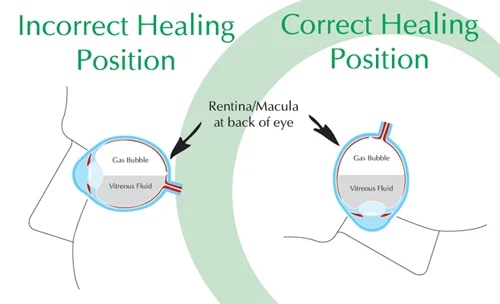
Following the procedure, your retina specialist may decide to place a gas or oil bubble in the eye to help hold the retina in place while it heals. You may be asked to maintain a face down position during the recovery period while the bubble is in place. The gas bubble needs to be kept in the correct place until a seal forms around the tear or detachment in the retina. Some patients may need to keep their head and eye in a face down position for approximately 90% of the day for the first 1 to 3 weeks after the surgery. You cannot lie on your back or the bubble will move to the front of the eye, press against the lens, potentially creating more problems.
The face down recovery position required, can be quite strenuous on your neck, back and joints without proper support. Our equipment help patients comply with their recommended recovery protocol, while maintaining comfort and functionality.
How To Care For Yourself At Home
Allow the eye to heal. Don’t do things that might cause you to move your head. This includes moving quickly, lifting anything heavy, or doing activities such as cleaning or gardening.
If your doctor used an oil or gas bubble to hold the retina in place, keep your head in a certain position for most of the day and night for 1 to 3 weeks after the surgery. Make a plan for this part of your recovery, because it will be hard to do some daily activities. Your doctor will give you specific instructions.
Do not lie on your back, or the bubble will move to the front of the eye and press against the lens instead of the retina.
If your doctor used a gas bubble, avoid airplane travel until your doctor tells you it is safe. This is because the change in altitude may cause the gas bubble to expand and increase the pressure inside the eye.
Your doctor will tell you if and when you can restart your medicines. He or she will also give you instructions about taking any new medicines.
You can shower and wash your hair and face. But don’t get any soap in your eye. You may want to use a wash cloth to wash your face.
Care instructions adapted under license by your healthcare professional. If you have questions about a medical condition or these instructions, always ask your healthcare professional. FDR Rentals LLC disclaims any warranty or liability for your use of this information.